Let's open this with a hard point: the few seconds your visitor takes to decide whether to leave or stay on your website are the most critical moment you should never neglect. Once they start loading the page, the experience has commenced, but if it fails to load, they have already made a judgment.
Website downtime does not present itself as a technological failure; it serves as a blank page with an error message or a delayed response, disrupting the intent. In these periods of interruption, people will form a perception about your company without having the opportunity to communicate with them clearly.
Besides, perception is not often objective. It leans towards skepticism. A long load time or a slow website equates to a company having either poor planning or a lack of care, which causes visitors to question the reliability of the business and the effectiveness of the systems. With so many options available, indecision quickly turns into an exit. That one small moment, which is typically undervalued, becomes a point of diminishing interest, decreasing confidence, and a lost chance at being considered a viable option.
Website downtime is more than a technical issue
On your end of things, a website down issue could mean hosting limitations, plugin conflicts, or a failure to apply any updates. However, your customers never see that "backend" of the website. What they run into is the friction caused by arriving with a purpose—to either browse, purchase, or inquire—only to encounter barriers in their path to complete their desired action when you are experiencing downtime.
The problem of website downtime causes conflict for your customers only.
An outage decreases user trust during that very period when it should be built up around your brand.
Availability is a component of the customer experience, along with IT availability.
The implication of this is straightforward: any instance of website downtime will contribute to how your brand is discerned by customers rather than how your systems perform.
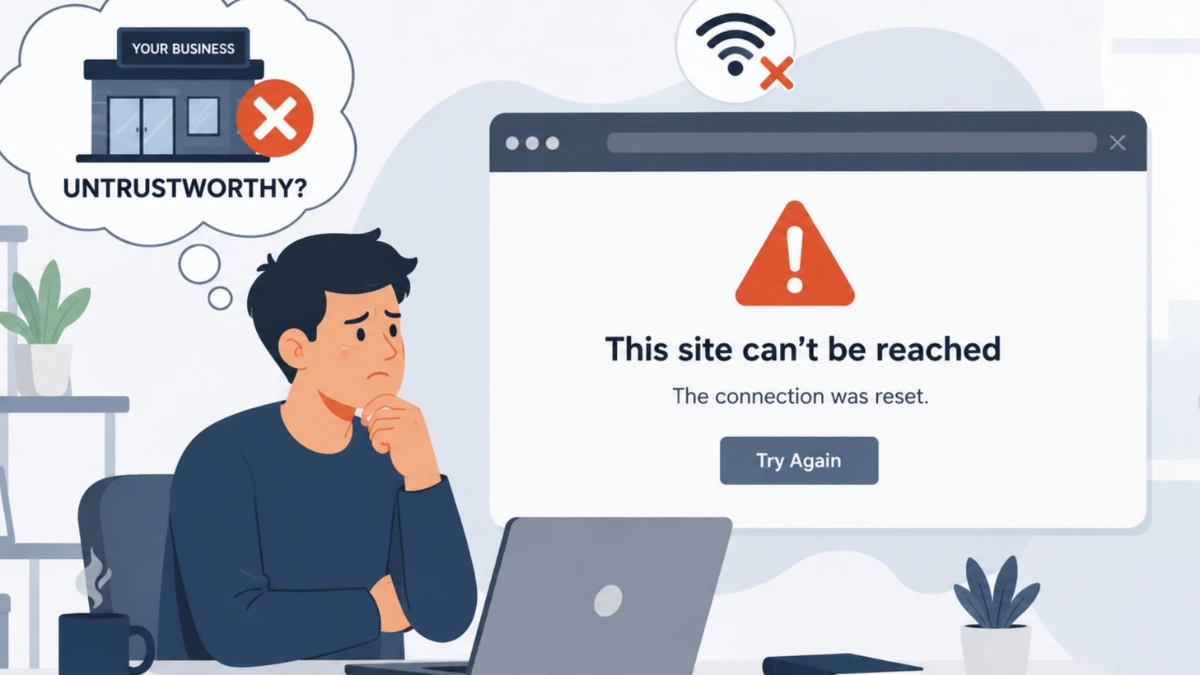
What customers assume when your website goes down
Although individuals tend not to express their reactions verbally, they typically react and form opinions quickly and quietly. The perception of your company can be influenced by the repeated downtimes on your website.
Your customers may think the following:
“This business might be untrustworthy."
“If their site is down, how can I expect their service to be reliable?"
“There are most likely other companies I could do business with."
Once your company's reputation begins to change due to the cost of downtime, you will start losing not just revenue, but also trust. And this repercussion is a much more difficult thing to regain than simply the transaction itself.
The business signals downtime sends
The impact of website outages extends beyond the immediate damage caused to the user experience. Even the most robust branding cannot eliminate the communication conveyed by website downtime; this communication, while subtle, is consistent.
Website downtime sends several signals to users:
Inconsistency
Inadequate professionalism
Risk developed at critical moments.
Possibly poor maintenance or support
If a website is essentially a nice-looking surface, it does not matter if it does not function and is displayed on the internet as unavailable. There is a long-term impact on established brands and perceived reliability when a website-down issue is visible, and this impression remains imprinted in a customer's mind after repeated occurrences of website downtime.
How downtime affects brand perception quietly
The impact of website downtime is rarely loud. It is quiet, and that is what makes it dangerous.
Most visitors will not complain
They will leave
First impressions are hard to recover
Repeated issues create a pattern
Users don’t usually take the effort required to report when a site is down and instead just move on to another site, usually within seconds of experiencing downtime. The lost interaction is not only a missed visit or opportunity to build a relationship, but also impacts future interactions with the user.
According to Gartner, the average cost of downtime can be roughly $5,600 per minute or more, depending on the scale of the business. That figure reflects revenue. What it does not fully capture is how quickly trust disappears the moment website downtime interrupts a user’s intent.
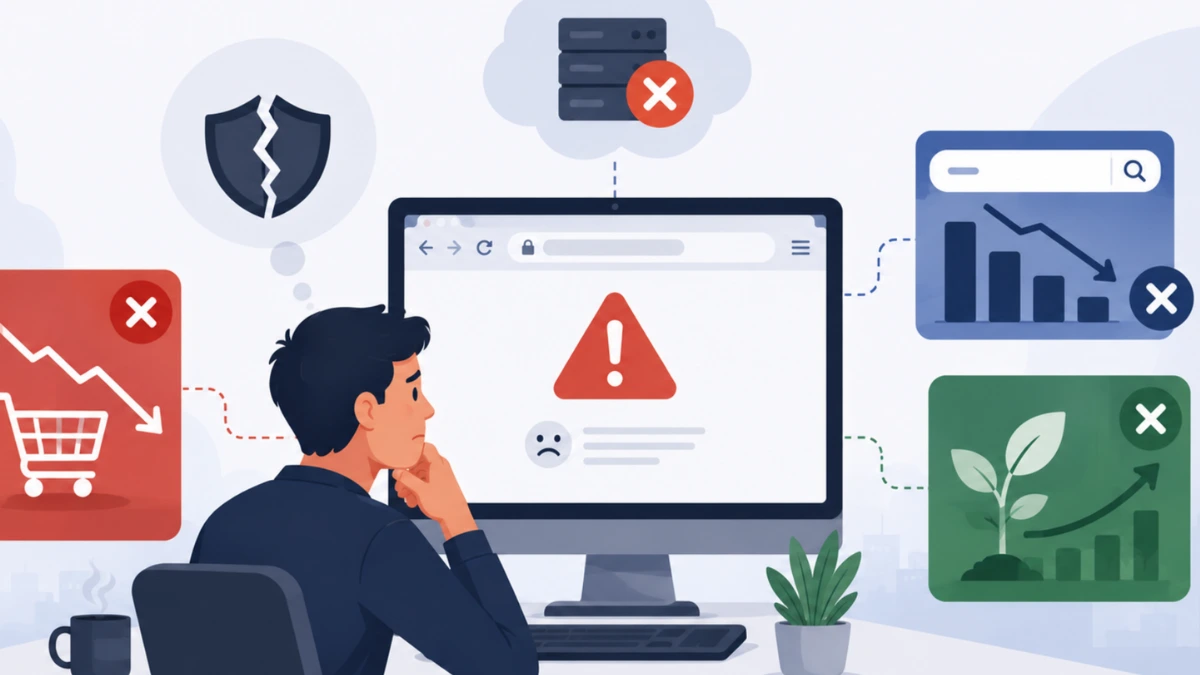
Downtime doesn’t just hurt sales. It affects trust, searchability, and growth
Downtime can certainly be framed as a financial issue; however, its longer-term effect can be seen in the growth (or lack thereof) of your business overall.
With each instance of website downtime, you lose customer trust.
Brand reputation becomes tied to reliability, not just messaging
Repeated instances of website downtime can diminish your search visibility.
In comparison with other businesses having continuously operating websites, the positioning of your industry will definitely be less favorable.
Moreover, there is the question of website downtime being detrimental for search engine rankings and index.
Search engines are monitoring stability; if your website has frequent instances of downtime, this will diminish your visibility over time. Thus, the cost of downtime increases beyond the immediate loss of revenue and starts to affect the long-term momentum of your business.
What does website downtime mean differently for each type of business
Website downtime has different meanings for each type of business, but the impact of the downtime is always associated with trust.
For an e-commerce brand: A website-down issue while trying to check out will cause an abandoned purchase, which means time lost and money lost.
For SaaS companies: Customer reliability is part of the product, so if a website goes down more often than it is up, it means your customers do not have faith in your products.
For service-based businesses: The service business’s website is often the customer’s first contact with the business. A customer will not have formed trust in the service business if they cannot navigate their website successfully.
For agency/freelance businesses: A freelancing agency that has gone through periods of website downtime raises issues of the ability of the agency/freelance professional to provide website maintenance and/or manage clients’ performance through the internet.
Remember: Different contexts, same conclusion. Reliability is non-negotiable. It is the baseline expectation across industries, not an added advantage. When your site fails in critical moments, everything else you offer becomes harder to trust.
Why reliability is part of your brand experience
Many people see branding as simply what we see (the visual identity) and the words we use (the messaging), but that's not the full story. Branding extends beyond the other two parts by including how a company behaves.
Without a stable website, even the best interface, most compelling copy, and most attractive images are worthless. The stability of a website contributes to a customer's experience of a brand in the real world. When a brand consistently has a site available, it creates a sense of confidence or trust in the brand. When their website frequently goes down, customers begin to question that brand.
Having a website with uptime, speed, and reliability is not just a bonus feature but part of a customer's overall experience with that brand.
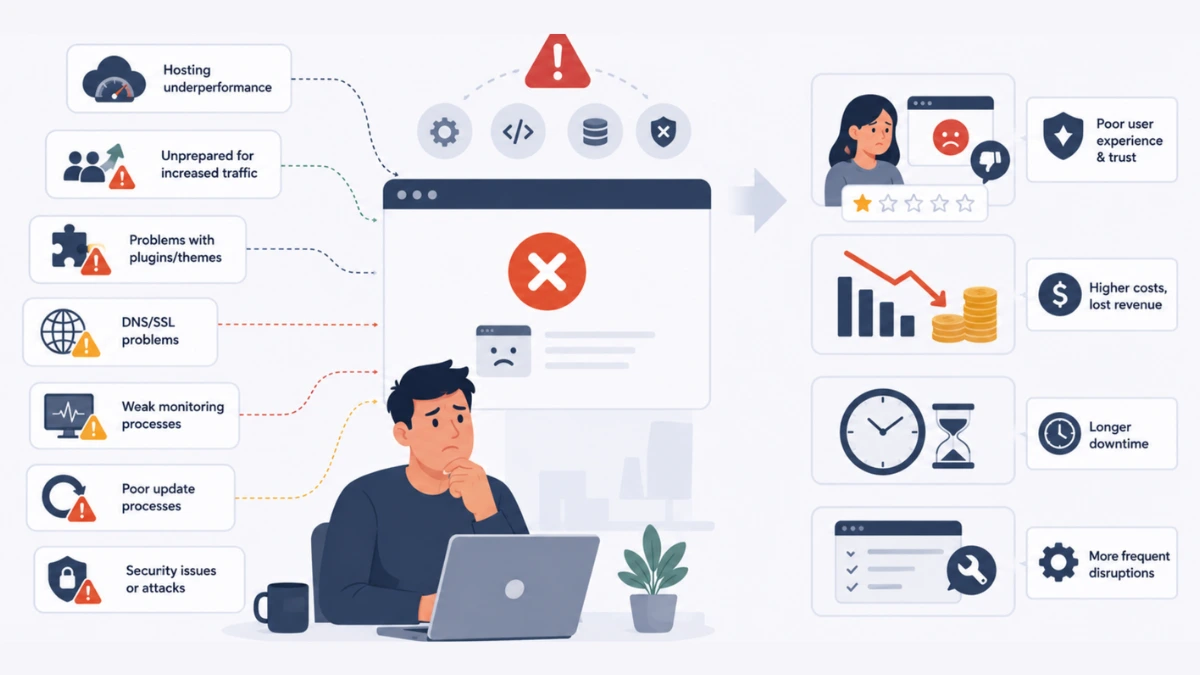
What causes website downtime that customers actually notice
The source of many of the concerns affecting clients is unknown; however, they do know how their end-users will feel about the impact of those events. Examples of major disruption can often relate to gaps in an organization's systems and processes, which would typically reflect how a business values stability:
Hosting underperformance
Unprepared for increased traffic
Problems with Plugins/Themes
DNS/SSL Problems
Weak monitoring processes
Poor update processes
Security issues or attacks.
The cumulative impact of these issues creates a higher operational risk for each website and increases total website maintenance costs, in addition to extending the length of time for any downtime occurring on that website. What starts as a simple mistake can rapidly turn into repetitive disruptions and negatively affect performance and public perception.
This is also the point where there is a lack of structure with regard to the website maintenance services, meaning that sites may not be updated regularly, monitored, or optimized. This neglect then results in the site going down more often and being down longer.
How to reduce the message downtime sends
To reduce downtime on a website, it is not just about fixing the issue but also about learning from that issue or preventing future experiences regarding that same downtime.
When choosing your hosting company, make sure to choose one that is built for stability
Has a comprehensive uptime monitoring report
Allows you to monitor critical paths for users
Has a plan for spikes in traffic
Continues to maintain the site proactively with routine updates
Has a backup plan and an incident response plan in place
When there are errors with the site or any downtime, clearly communicate with users what the issues are and how long it will take for them to be resolved
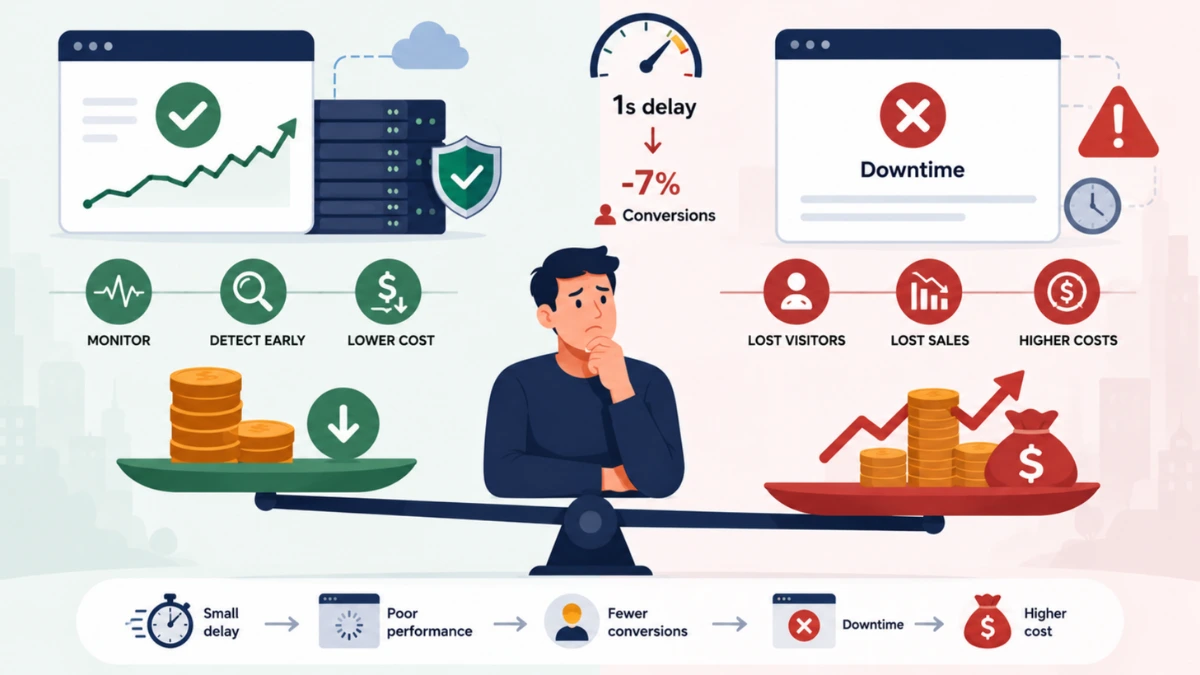
Small delays cost. Downtime costs more.
Companies with strong infrastructure have lower outages and lower long-term maintenance on their websites. Companies that monitor their sites can reduce the cost of outages through early detection of problems. Even small performance factors are significant when it comes to conversion. According to a research study, one second of delay can reduce your conversions by as much as 7%.
If you have small amounts of delay that affect how people behave, you will have even more significant impacts if your website is down completely. There are additional habits that can help as well: Teams that optimize baseline assets and workflows reduce unnecessary load and improve overall site stability Small optimizations, such as simplifying assets or using tools like a background remover to reduce file weight, can improve load performance and support a more stable site experience Consistent use of templates and standardized tools minimizes errors that can lead to disruptions or downtime These result in more stable sites. Therefore, investing in quality, regular maintenance services becomes a long-term strategy for managing your website, controlling costs, and ensuring consistent performance. Final takeaway Every company focuses on the appearance of its business, but few invest in how consistently it works. Over time, customers will see both and ultimately will see consistency as a stronger signal of your business. Again, website downtime doesn't just create a disruption. It demonstrates a lack of preparedness, reliability, and responsiveness when the business needs to perform at its highest level. Every time a website goes down, it alters the way customers view your brand, whether they will continue to do transactions with you, and whether they will come back in the future (or never do).
Apart from the immediate financial loss due to the website downtime, the main price you have to pay is reduced trust, lowered perception, and eventually slower development of your business in the long term. Website maintenance cost management is not about searching the ways to save on it but to create certain mechanisms of preventing issues.
Here is where effective website maintenance services become crucial. These services guarantee that your company's website is stable, up-to-date and prepared for any interaction with customers.
After all, reducing website downtime is a business decision that will strengthen your credibility, foster future business, and create a predictable customer experience that builds loyalty. Because in an overly saturated industry, where everything is one click away, the brands that stay available are the ones that stay chosen.